
A pioneering pilot project has proven that commercial ROVs can be utilised for new scientific insights during their routine operations and is now entering its second phase after revealing new insights into what North Sea sediments can tell us about past human activity and carbon storage.
The work was made possible through the BORA Blue Ocean Research Alliance®, a partnership between the National Oceanography Centre (NOC) and Subsea7/Seaway7 that demonstrates how industry infrastructure and academic research can work together at minimal extra cost. The pilot sediment sampling project successfully trialled a push-core system on the ROV’s robotic arm that recovered six intact sediment cores across three North Sea locations.
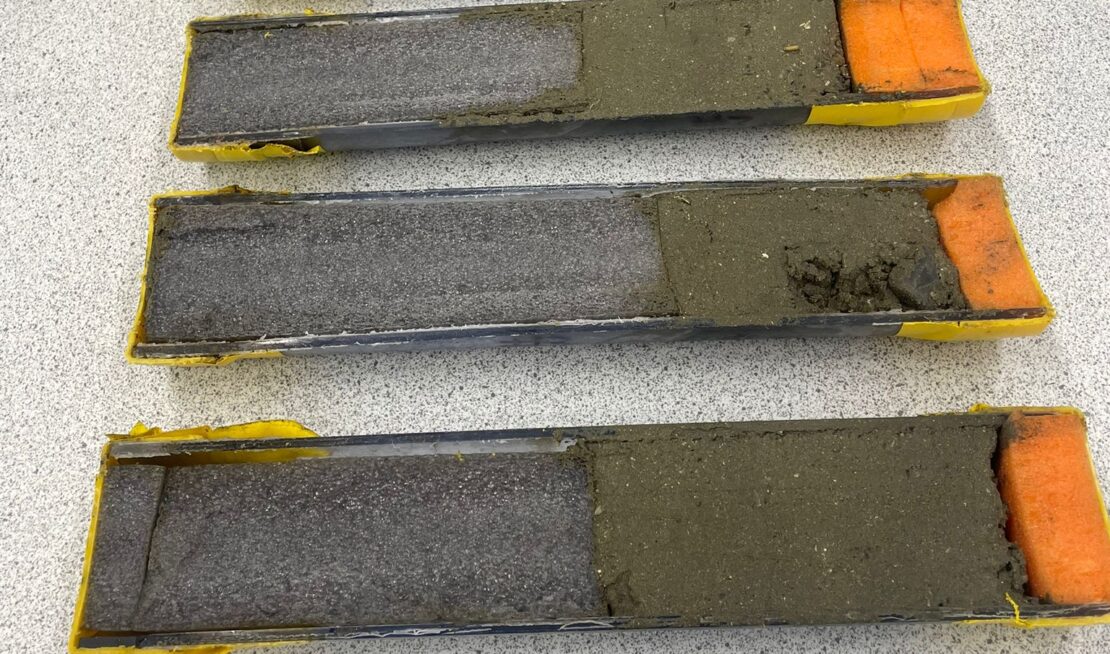
Analysis by the British Ocean Sediment Core Research Facility (BOSCORF) found a consistent three-layer structure in every core, with each layer showing its own physical and chemical characteristics. Most significantly, the cores contained a distinct increase in barium and lead within the upper few centimetres of sediment at multiple sites. The two elements appear together in the same relatively recent layer, suggesting that they may reflect human activity in the area rather than natural changes in the seabed.
The finding could provide a valuable new way to understand how the seabed has changed over time. If researchers can link the depth of this chemical signal to the timing of known industrial activity, such as potential historical offshore industrial activity, they may be able to establish how quickly sediment has accumulated at the site. This is important because knowing the age and accumulation rate of sediment helps scientists understand how much carbon the seabed is storing, and how vulnerable that carbon may be to disturbance.
Phil Bishop, the NOC’s BORA Blue Ocean Research Alliance® Director, said “This pilot has successfully demonstrated a blueprint for how commercial ROV operations can contribute to global scientific research. By integrating sediment sampling into routine offshore activity, we have shown the enormous potential to dramatically increase the scale and frequency of seabed observations across the world’s oceans. We hope this approach can now be built upon by industry and the scientific community, unlocking new opportunities to collect the data needed to better understand our changing ocean.”
A recent study demonstrated that in the English North Sea estimated 98% of organic marine carbon is stored within seabed sediments*. Hotspots like these may be susceptible to disturbance from activities such as bottom trawling and infrastructure development which potentially releasing stored carbon, underlining the importance of understanding how such activities may affect seabed carbon stores.
The initial pilot analysed six sediment cores collected from three offshore locations. While relatively small in scale, the results were encouraging and highlighted opportunities for further investigation. In 2026, Phase 2 is being mobilised and shortly underway to collect the baseline data needed to better understand and model this risk, deploying a standardised push-core kit across Subsea7’s ROV fleet, carrying out deeper laboratory analysis to build on the initial findings, and publishing peer-reviewed research.
Liz James, Group Environmental Director as Subsea7 said, “One of the strengths of this project is its ability to build on capabilities that already exist offshore, enabling us to support marine science with minimal additional operational impact. Phase 2 offers an important opportunity to strengthen the evidence base around seabed carbon while generating insights that can help inform future offshore development and decommissioning activities.”
All samples and data will be released open access through BOSCORF, extending the Alliance’s contribution to marine science well beyond the life of the project and creating a resource that can support future research and more informed decision-making around North Sea development and decommissioning.


